$CHAIN Auction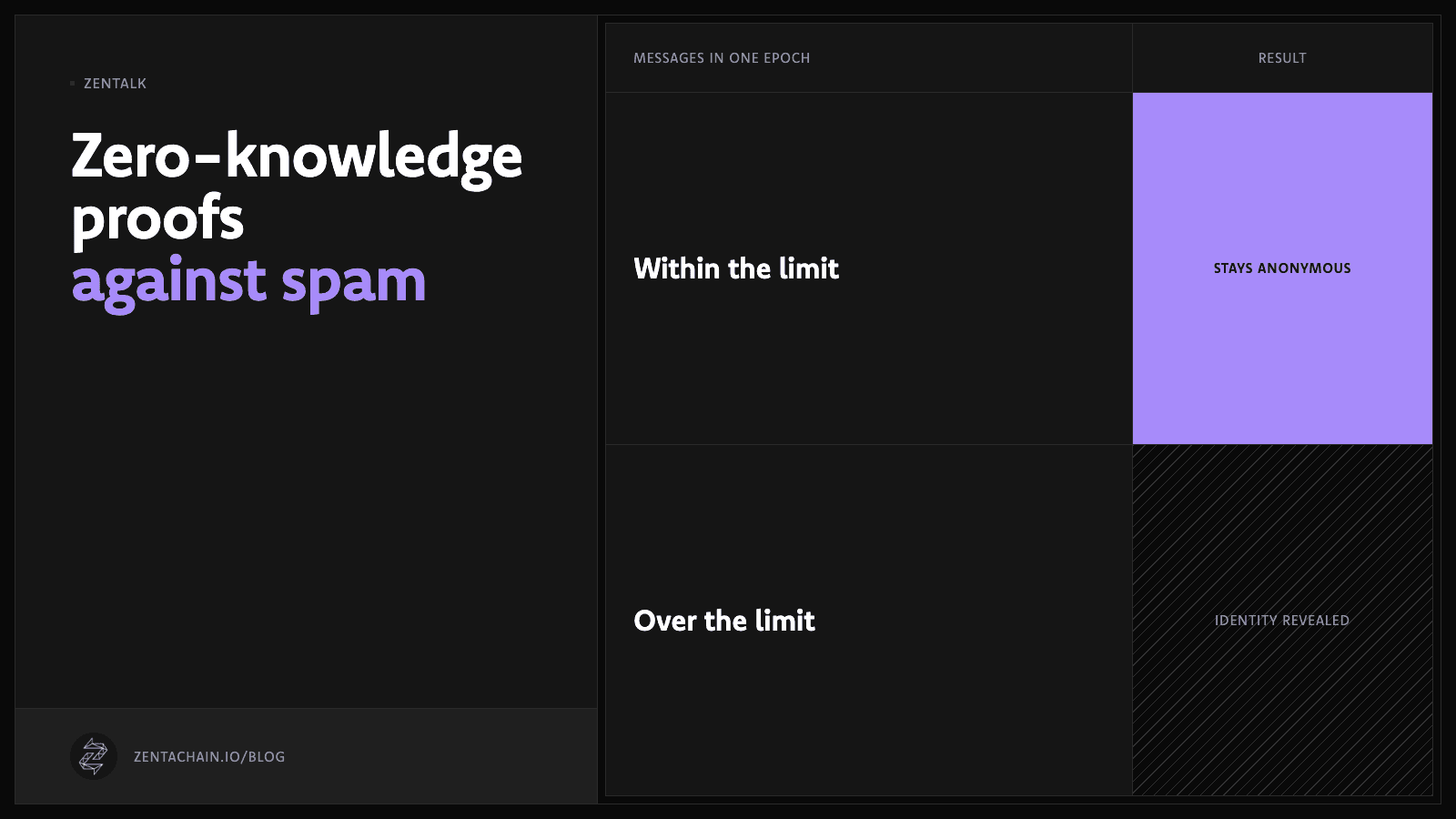
The moment a messaging network hides its users' identities, it becomes trivially spammable. Wallet-based identity without a spam gate invites exactly this failure. A botnet operator registers ten thousand accounts — each pseudonymous, each unverifiable — and floods every channel simultaneously. The network cannot ban them without knowing who they are, and knowing who they are destroys the privacy it was built to provide. Anonymity and spam resistance have been mutually exclusive. Until the math changed.
The unsolved engineering problem of anonymity networks for two decades has been this: if the system does not know who its users are, how does it stop the ones who abuse it? Tor has partial answers. Traditional decentralized networks have partial answers. Most of them involve either allowing the abuse and hoping the legitimate use outweighs it, or introducing identity hooks that undercut the anonymity property the network was supposed to provide in the first place. Neither is a real solution.
Zentalk uses a cryptographic construction called Rate-Limiting Nullifier — RLN for short — to solve the problem without the trade-off. A user can prove, anonymously and unforgeably, that they are sending within their rate limit, without revealing who they are. A user who tries to exceed the rate limit automatically leaks enough information for the network to identify and expel them, while users who behave remain cryptographically invisible. It is the closest thing the field has to a clean solution, and it is what makes Zentalk's anonymity practical rather than aspirational.
Why spam is an anonymity problem
The structural conflict runs deeper than it first appears. A normal service stops spam by identifying the offender. IP addresses are banned. Accounts are suspended. Phone numbers are blocklisted. The enforcement works because the service knows who is doing what.
An anonymity network cannot use any of those tools without dismantling the anonymity. If the routing layer logs IP addresses to ban offenders, it also logs IP addresses of every legitimate user, and the privacy property collapses. If every user is required to have a verifiable identity so that bad ones can be banned, the identity exposure hits everyone, not just the attackers.
The structural problem is that classical anti-abuse works by knowing. Cryptographic anti-abuse, to preserve anonymity, has to work by proving — proving behavior without revealing identity, and revealing identity only when behavior crosses a pre-committed threshold.
What a zero-knowledge proof gives you
A zero-knowledge proof lets one party convince another that a statement is true, without revealing anything about why the statement is true beyond the fact that it is true.
Concretely for RLN: a user can prove "I am a registered member of the network, and this is the Nth message I have sent in the current epoch, and N is below the rate limit" without revealing their membership credential, their identity, their history, or anything else. The network verifies the proof and forwards the message. Nothing about the proof ties it to the user's identity or to any previous message they sent.
The cryptographic magic is that the proof is both convincing and non-leaky. The verifier gains no information other than "this proof is valid." If the proof is invalid, the message is rejected, and the user's identity remains protected because they never successfully submitted anything.
The rate-limiting trick
The first component is standard zero-knowledge. The second component — the rate-limiting part — is what makes RLN novel.
When a user registers with the network, they deposit a stake and are issued a membership secret. The secret is private. For each epoch (say, a minute), the user is entitled to send up to K messages. Each message they send includes a zero-knowledge proof derived from their secret and from a message-counter nullifier. The math guarantees that if they send K or fewer messages in the epoch, each proof is unique and leaks nothing about the secret.
If they try to send a (K+1)th message in the same epoch, the construction forces them to reuse nullifier data, and the reuse mathematically exposes the secret. The network can now derive the user's secret from two messages that should not have coexisted, and the network can use that secret to identify, slash, and expel the account. The moment a user exceeds the rate limit, they self-dox. The moment they stay within it, they are perfectly anonymous.
The incentive alignment
RLN turns abuse into a self-punishing operation. A legitimate user sending normal traffic never triggers the identity disclosure, because they never exceed the limit. A spammer attempting to send thousands of messages per minute is forced to either stop — at which point their anonymity is intact and they cannot achieve their attack — or to exceed the rate, at which point their stake is forfeit and they are banned from the network.
The economic construction reinforces the cryptographic one. Spamming requires either registering many separate identities (each of which costs a stake deposit) or burning one identity per brief burst (which is expensive). Neither scales. Legitimate high-volume users — automated services, community bots with genuine purpose — can register with higher rate limits or multiple staked identities, and the honest cost is bearable. Abuse at scale becomes economically infeasible before the cryptographic anonymity is ever in question.
Where RLN fits in the stack
RLN is not Zentalk's encryption layer. It is not the identity layer. It is a gating mechanism sitting in front of the messaging network, ensuring that the anonymous traffic the network carries is anonymous traffic from entitled participants rather than anonymous traffic from anyone willing to burn bandwidth.
The encryption stack handles what the messages contain. The identity layer handles what a Zentalk account is. RLN handles whether this particular message should be admitted onto the network in the first place. It is the part of the system that keeps the anonymity useful by keeping the network clean.
What this replaces
Legacy anti-spam at the messenger layer works by analyzing patterns — frequency, content similarity, metadata signatures — and flagging suspected abuse for human review or account suspension. All of it requires the platform to observe the traffic in identifiable form. All of it fails immediately when the traffic is anonymous or end-to-end encrypted, because the observable signal disappears.
RLN replaces pattern analysis with mathematical enforcement. The question "is this user abusing the network?" is answered by the proof construction itself, not by heuristic analysis of traffic patterns. The question "who is the abusing user?" is answered only when abuse actually occurs, and then unambiguously. The false-positive rate is structurally zero. The false-negative rate is structurally zero within the rate-limit contract.
Trade-offs, honestly
RLN is not free of costs. Zero-knowledge proof generation takes computational work on the sender's device — measured in milliseconds with modern proof systems, but not zero. Proof verification at the network layer is also non-trivial. For Zentalk, the cost is amortized across the validator set and remains well below what would be user-perceptible.
The rate limit itself is a design parameter. Setting it too high weakens spam resistance. Setting it too low constrains legitimate users. Zentalk's parameters are chosen to comfortably accommodate normal human messaging patterns while making bot-scale abuse economically unsustainable. They are adjustable as the network matures, through governance votes of the PoC-staked token holders rather than unilateral decisions by any operator.
What the user notices
In normal operation, nothing. The RLN proof is generated automatically with every message. The verification happens at the network layer. The user experience is sending a message and having it arrive. The cryptographic complexity is entirely backgrounded.
What the user benefits from is a network that is not clogged with spam, not overrun with bot traffic, and not dependent on a centralized platform to keep the garbage out. The network keeps itself clean, through mathematics, without knowing who its legitimate users are. That is the promise RLN makes good on, and it is why Zentalk can provide anonymity that is actually usable rather than theoretically pure but practically unusable.
Thanks & Best Regards Zentachain Team!