$CHAIN Auction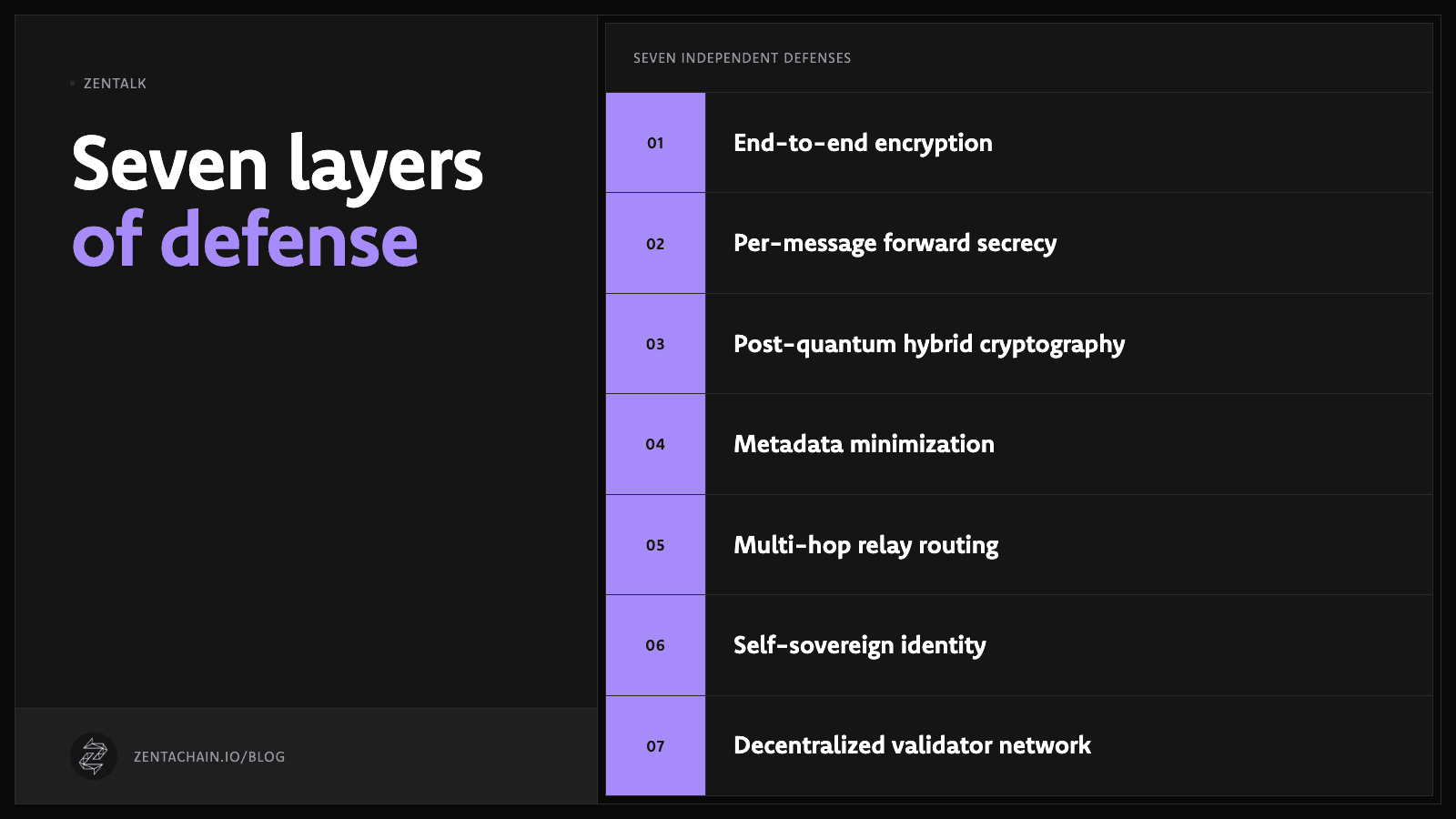
One lock gets picked. Seven locks do not.
Any single defense will eventually fail. A cipher will be weakened by new cryptanalysis. A library will ship a bug. A key will leak. A protocol edge case will turn out to have an unintended property. The only protection that survives contact with reality is a stack of independent defenses, arranged so that breaking one does not break the system.
Zentalk is built around seven such layers. Each one addresses a different attack class. Each one is independent of the others. An adversary who defeats one is not meaningfully closer to defeating the next. The purpose of this article is to walk through them in order and explain what each protects against, what each does not protect against, and why the stack as a whole is the unit of security rather than any individual layer.
Layer 1: End-to-end encryption
Content Isolation:
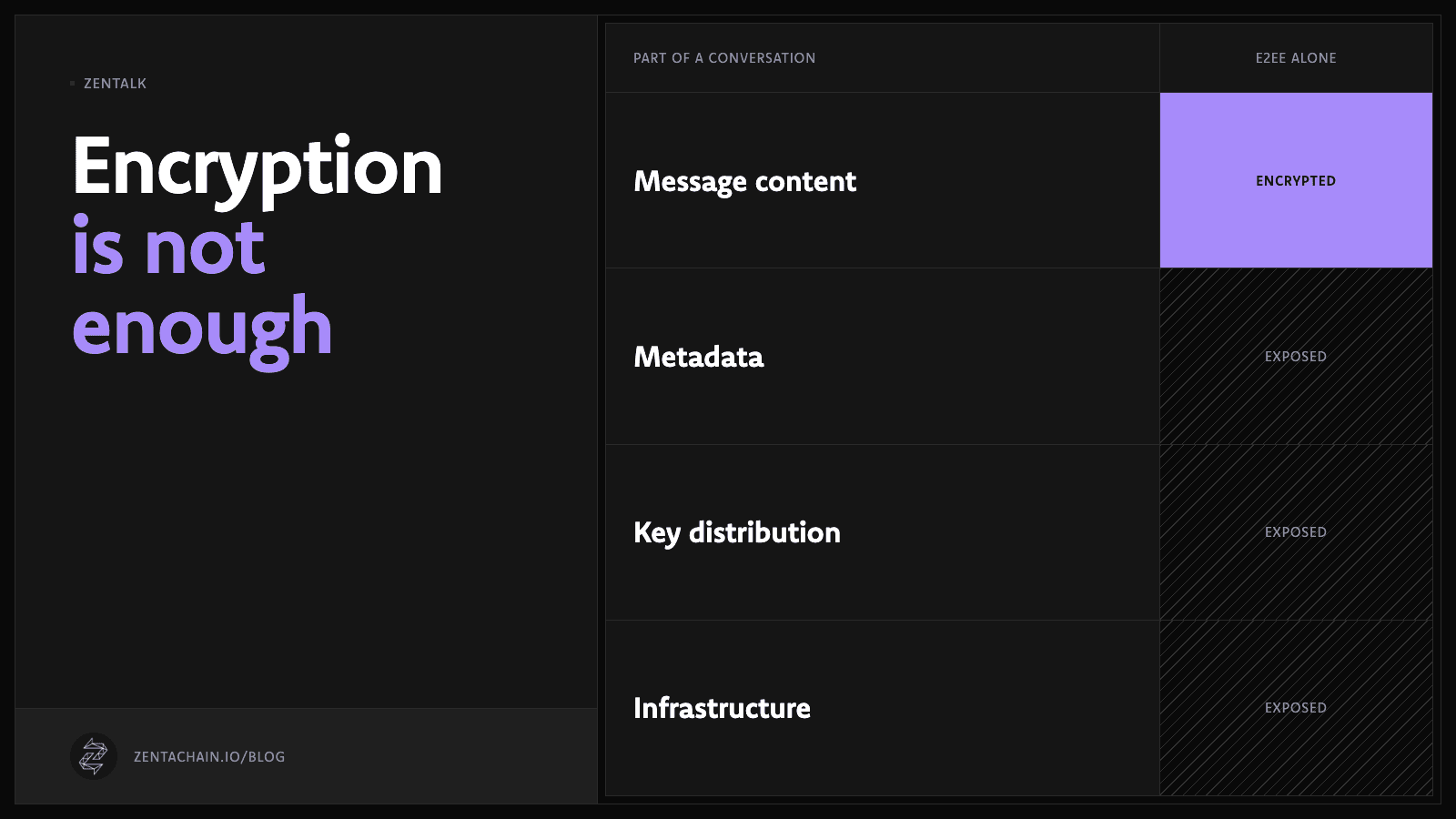
No intermediary — validator, relay, network operator — holds the decryption key at any point in transit. The message body is sealed on the sender's device and opened only on the recipient's.
The message body is encrypted on the sender's device and decrypted on the recipient's device. No intermediary — validator, relay, network operator — holds the decryption key. This layer protects content confidentiality against the wire and against the network infrastructure itself.
It does not protect against a compromised endpoint, a screenshotting contact, or a keyboard logger. Those are separate problems addressed by separate layers or by user practice.
Layer 2: Per-message forward secrecy
Every message is encrypted under a key that exists only for that message. The key is derived through the Double Ratchet and discarded after use. Forward secrecy ensures that compromise of the current device state does not retroactively expose prior messages.
This layer is what makes device seizure a narrow rather than catastrophic event. An investigator with your phone in a lab cannot recover last year's conversations, because the keys that encrypted them no longer exist anywhere.
Layer 3: Post-quantum hybrid cryptography
Harvest-Now-Decrypt-Later Defense:
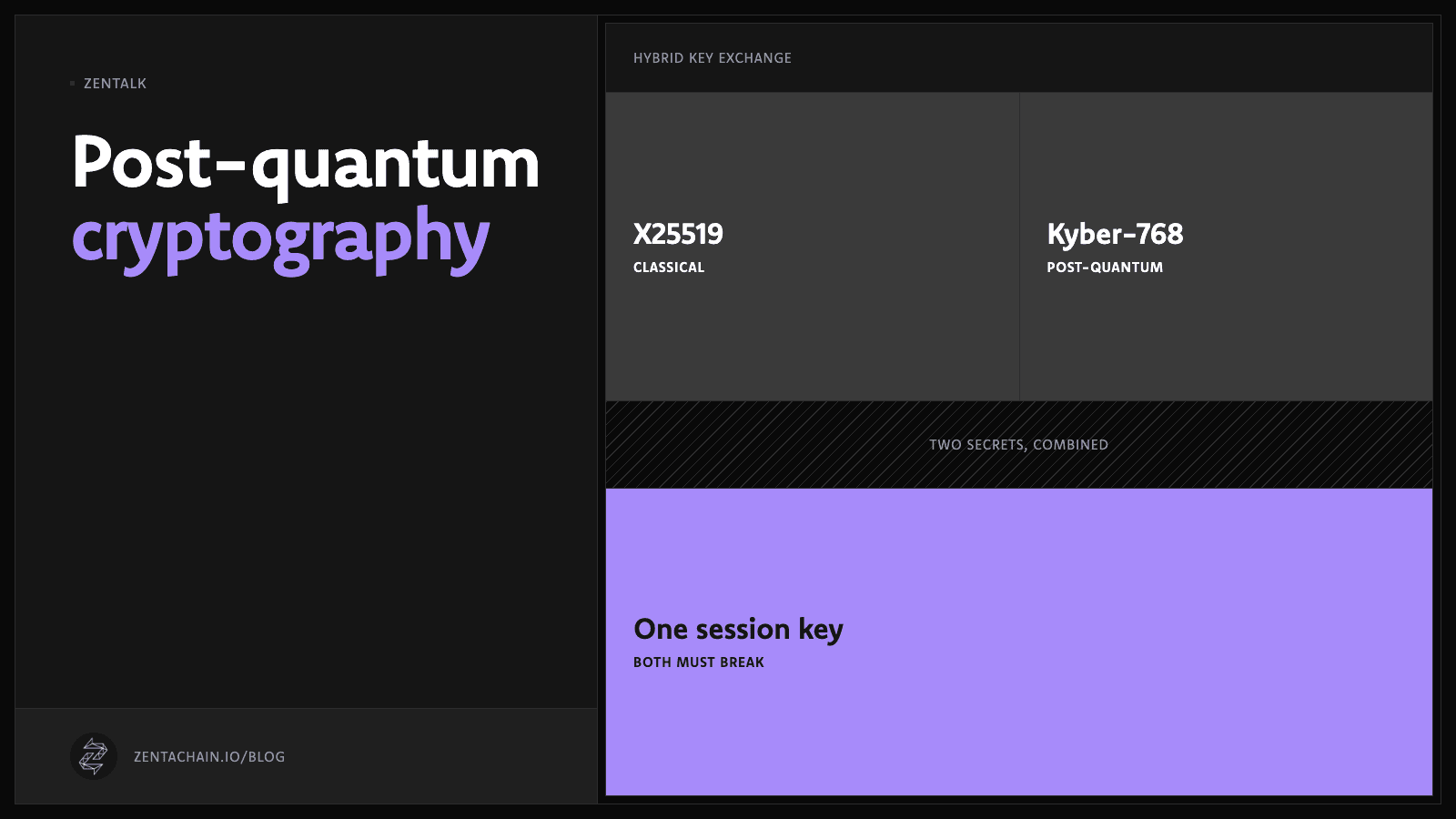
Ciphertext recorded today remains unreadable when quantum hardware arrives, because the session key is derived from both X25519 and Kyber-768. Breaking one primitive gains the attacker nothing — the other still holds.
Every key exchange is performed twice: once with X25519, once with Kyber-768. The session key is derived from both. If either primitive breaks — whether through a classical advance against X25519 or a lattice advance against Kyber — the session remains protected by the other.
This layer addresses the harvest-now-decrypt-later threat. Ciphertext recorded today remains unreadable when quantum hardware arrives, because the key material does not rely solely on assumptions that quantum hardware can break.
Layer 4: Metadata minimization
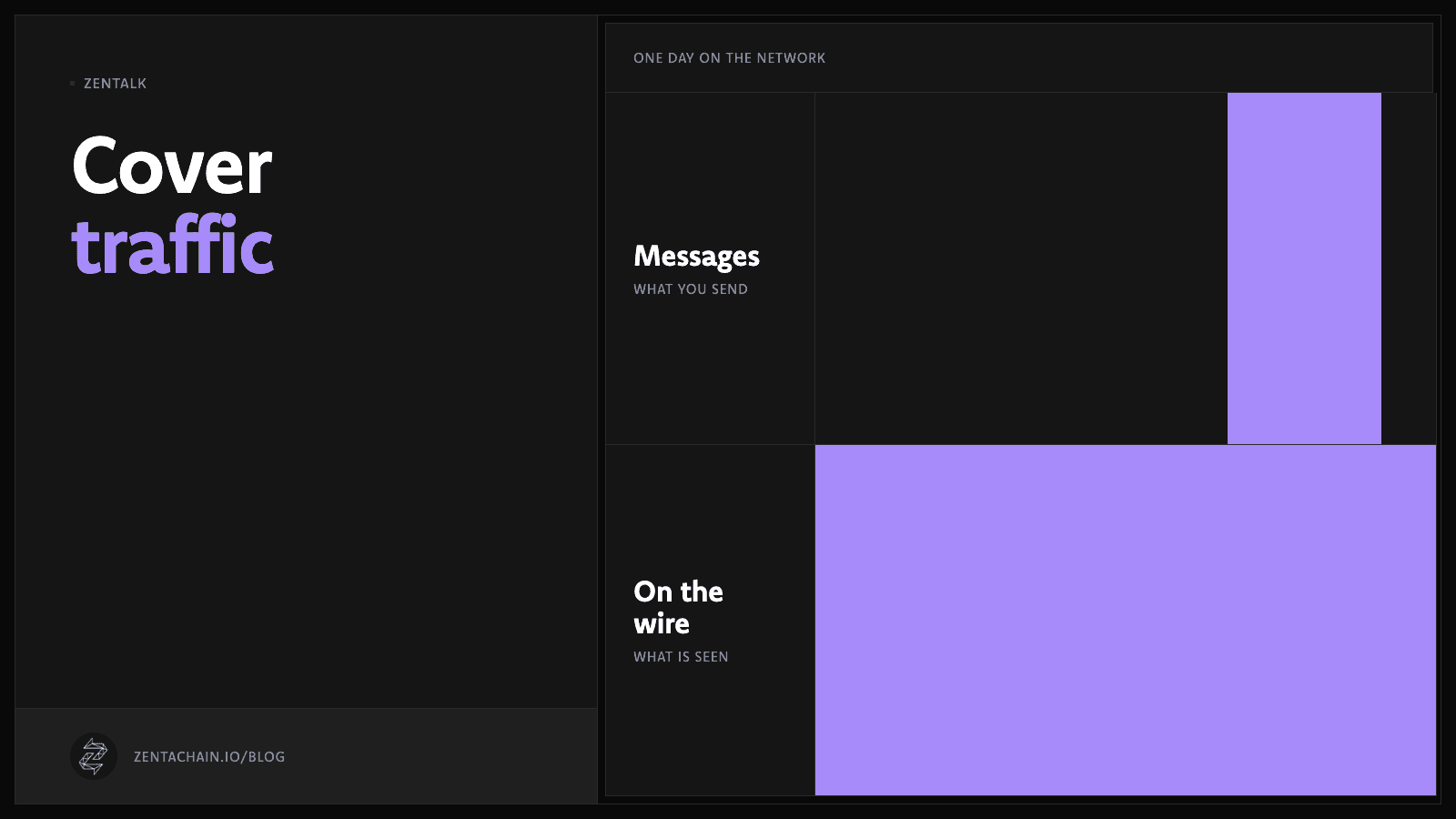
Routing uses hashed identifiers. Sender identity is sealed inside the payload. Messages are padded to fixed sizes. Cover traffic obscures timing patterns. The envelope leaks as little as the laws of network routing allow.
This layer is what prevents the "we kill people based on metadata" attack. Even if an adversary cannot read the content, they cannot reliably reconstruct who spoke to whom, when, how often, or in what volume.
Layer 5: Multi-hop relay routing
When high-assurance mode is enabled, messages pass through three independent relay nodes, each wrapped in RSA-4096 encryption layers. The first relay sees the sender but not the destination. The last relay sees the destination but not the sender. No single relay observes the full path.
This layer defeats the single-relay compromise. An adversary who controls or subpoenas one validator learns fragments. An adversary who wants the full routing graph must compromise the majority of the path across independent operators simultaneously, which is an operation most adversaries cannot execute even at state scale.
Layer 6: Self-sovereign identity
No Registrar to Subpoena:
Identity is a keypair generated on the user's device. There is no support line to social-engineer. There is no SIM to swap. An entire category of carrier-level hijacking attacks simply has no surface to operate against.
Accounts are cryptographic wallets, not phone numbers or email addresses — a self-sovereign identity model. There is no registrar to subpoena. There is no support line to social-engineer. There is no SIM to swap. Identity is a keypair under the user's exclusive control.
This layer removes an entire category of attacks that have become dominant against mainstream messengers: carrier-level account hijacking, customer-service social engineering, and mass-directory leaks. The attack surface simply does not exist in Zentalk's identity model.
Layer 7: Decentralized validator network
The infrastructure is operated by independent validators, each staking CHAIN tokens, each auditable on-chain, each replaceable. No single company, jurisdiction, or operator controls the network. The network continues to function when individual validators go offline, collude, or are ordered to cooperate with a legal request.
This layer defeats the single-point-of-capture problem that every centralized messenger suffers from. WhatsApp can be compelled as an entity. Signal's servers exist in specific jurisdictions. Zentalk, as a network, cannot be compelled, because the network is the operators and the operators are many.
Why seven, not one
Every layer in this stack is independent. Each addresses a different adversary capability. Compromise of end-to-end encryption does not help an attacker defeat metadata protection. Compromise of the validator network does not help an attacker defeat forward secrecy. Compromise of the identity layer does not help an attacker defeat post-quantum encryption.
Defense in depth does not mean seven layers each of which is probably fine. It means seven layers each of which is sufficient by itself, and whose combination requires an adversary to succeed at seven independent things at once.
No realistic adversary has that kind of surface capability. A state-level adversary may be able to break one layer through a specific capability. Breaking seven layers simultaneously, repeatedly, across a user base of independent identities on a decentralized network, is not a technical operation. It is an impossible one.
Honest limits
Honesty about threat models is a defense in itself. Zentalk's seven layers do not protect against:
- A compromised endpoint — malware on your device reads messages after they decrypt, regardless of how strong the protocol is
- A coerced counterpart — the person you are messaging can be pressured to share the conversation
- Physical surveillance — cameras, microphones, and shoulder-surfing do not care about relay routing
- Network-level existence revealing — an adversary watching your internet connection can tell that you are using Zentalk, even if they cannot tell what you are saying
These are real limits. Zentalk does not claim to solve them. It claims to solve everything the protocol is supposed to solve, at a standard that does not depend on any single assumption holding forever.
Verify the stack
Each of the seven layers is specified, open source, and testable. You do not have to believe the stack is built. You can inspect the code, verify the handshakes, observe the routing behavior, audit the validator set, and read the identity-layer documentation. The claims are falsifiable, which is what distinguishes a security architecture from a marketing section in an app store listing.
Thanks & Best Regards Zentachain Team!