$CHAIN Auction
Two people exchange encrypted messages every evening between 9 PM and 11 PM. The messages are unreadable. The pattern is not. This is metadata surveillance in its simplest form. An observer watching the network for a week knows the exchange exists, knows its schedule, and knows the approximate volume, without decrypting anything. From that pattern, relationships are inferred, conversations are dated, and absences are flagged. Traffic analysis is the oldest surveillance discipline, and it survives every cryptographic advance that targets only the content.
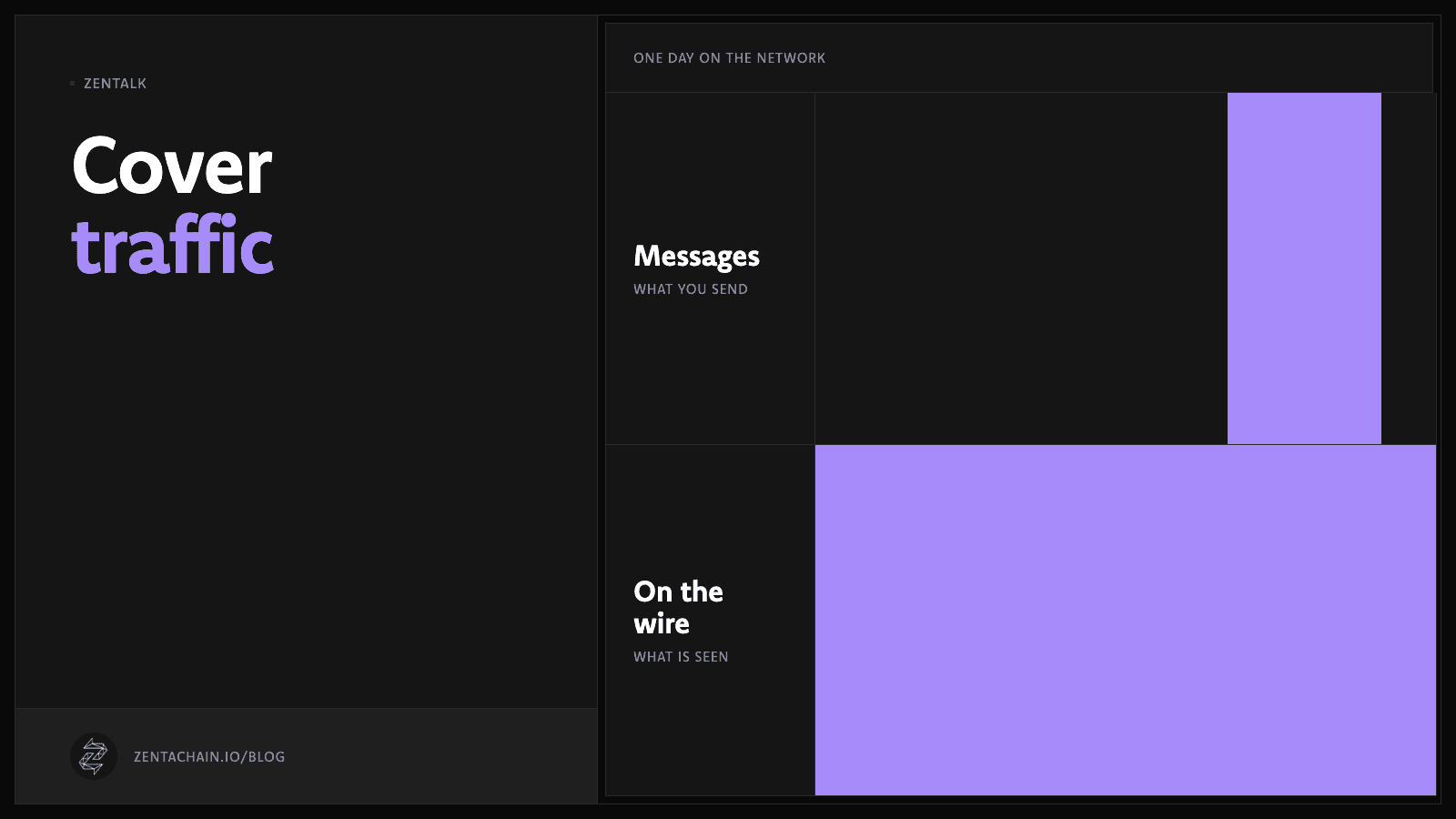
Zentalk's defense is cover traffic: the network transmits packets whose sole purpose is to obscure the pattern of real packets. The result is that from the wire's perspective, a user at rest and a user in active conversation look the same. Stealth addresses address the destination-linkability vector that accumulates over time. The observer learns nothing from timing or volume that they did not already know.
The problem encryption does not solve
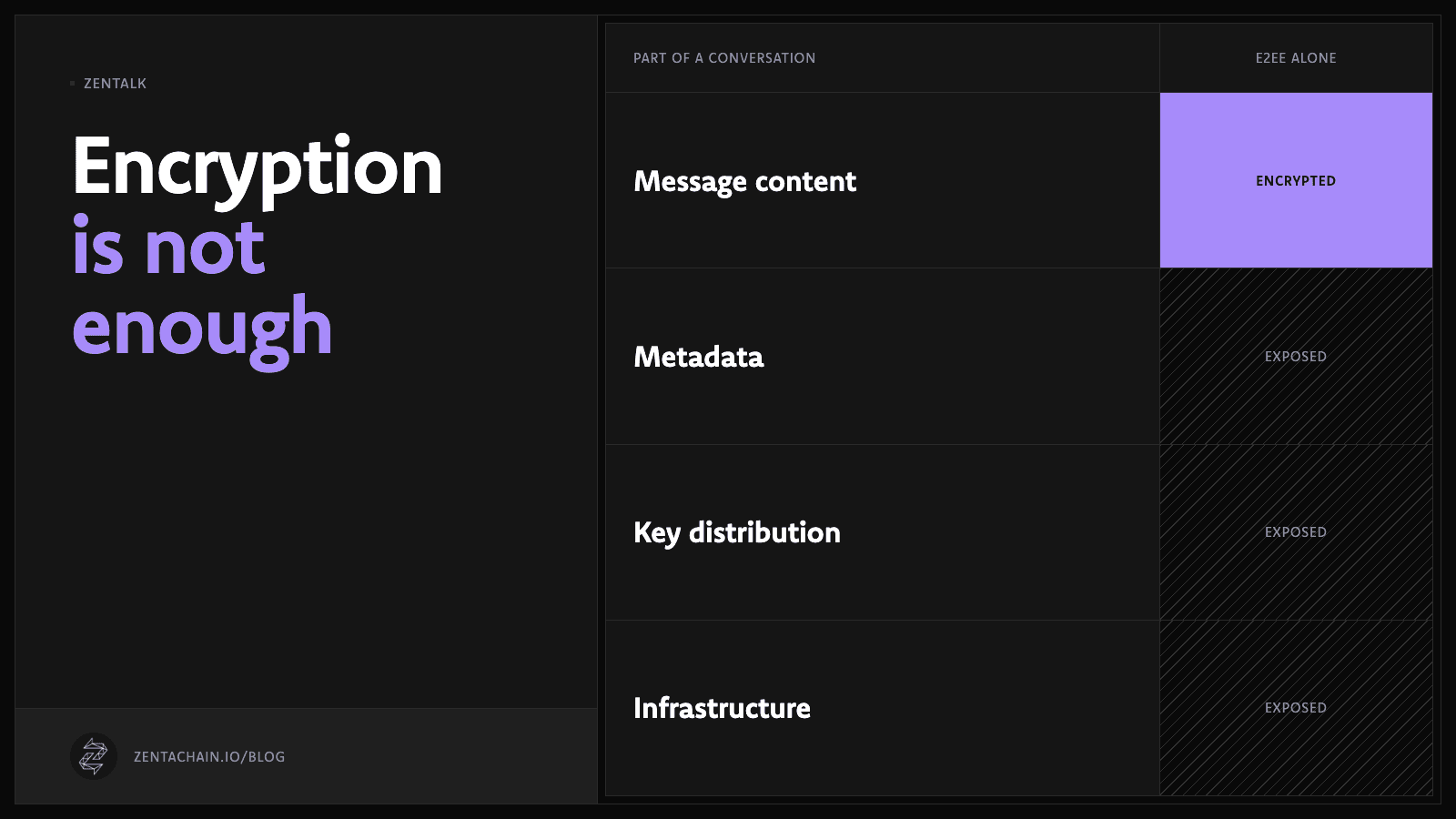
Cryptographers spent decades perfecting ciphers that resist cryptanalysis. That work solved the content problem. It did not solve the metadata problem. A message that is perfectly encrypted still announces its existence by appearing on the wire. Its size is measurable. Its timing is recordable. The pattern across many messages forms a signal that survives even perfect content protection.
Classical traffic analysis uses this signal to reconstruct relationships, detect anomalies, and flag events. During the Second World War, Allied cryptanalysts routinely derived significant intelligence from German Enigma traffic volume alone, before decrypting the content. The discipline has matured since, but the primitive is the same: observe the pattern, infer the behavior.
What cover traffic does
Cover traffic is cryptographically indistinguishable from real traffic. Each Zentalk client, at irregular intervals, emits messages that look identical to real messages on the wire — same size, same encryption layer, same routing envelope — but are addressed to a null recipient and discarded on arrival. Real messages are interleaved with the cover stream. An observer cannot tell which packets carry payload and which are chaff.
The interval distribution is carefully chosen. A regular beacon of cover packets would be easy to subtract out, leaving the real traffic visible. Zentalk samples from a Poisson process whose rate is tuned to user activity patterns. A user who has not opened the app still emits background cover traffic, so their silence on the wire does not correspond to silence in their conversation. A user actively messaging emits both real and cover packets, with the cover layer smoothing the burstiness that would otherwise signal active use.
Fixed-size padding
Cover traffic alone is not enough. If real messages have varied sizes and cover packets are a fixed size, the size distribution still leaks which packets are real. Zentalk pads all messages to fixed size classes. A one-word text message and a fifty-word text message produce ciphertexts of the same size on the wire. A small photograph and a short voice clip may produce ciphertexts of the same larger size. The size alone does not distinguish content types.
The cost is bandwidth: short messages pay overhead compared to their true size. The benefit is that an observer cannot correlate message sizes with known content profiles (short replies vs. long explanations, for example), and cannot distinguish messaging from background cover traffic based on packet dimensions.
Timing obfuscation
Beyond volume and size, the arrival distribution of packets carries information. A burst of ten packets followed by silence reveals active use. Regular packets at fixed intervals reveal a beacon. Zentalk's client introduces randomized delays in message transmission — typically milliseconds to low seconds — so the emission pattern does not map cleanly to the user's typing rhythm. Combined with the cover traffic, the result is a smoothed distribution that carries roughly the same signal whether the user is actively conversing or not.
The delays are small enough to be imperceptible in normal messaging. A message sent does not feel slower. A reply does not feel delayed. The obfuscation happens entirely in the part of the latency budget that users do not notice.
What this protects against
The attack model is a passive observer of network traffic. This includes ISPs logging connection records, intelligence agencies tapping fiber, network operators selling behavioral data, and anyone with access to flow records from downstream routers. Against all of these, cover traffic denies the observer the pattern information they would otherwise extract without needing to decrypt anything.
Cover traffic does not protect against an active adversary controlling both endpoints of a routing path. Routing addresses the multi-hop path problem separately. It does not protect against the application layer (a compromised client sees the real traffic and ignores the cover). It does not protect against long-term correlation attacks that combine traffic analysis with other signals. It closes the passive-traffic-analysis vector, which is the broadest, cheapest, and most commonly deployed surveillance method.
The cost-benefit reality
Cover traffic is not free. It increases bandwidth consumption, especially for users who otherwise would have been idle. For a typical user, the overhead is modest — a few megabytes per day, comparable to background sync traffic from any modern application. For users on metered or constrained connections, Zentalk offers a reduced cover-traffic mode that maintains baseline obfuscation at lower volume.
The benefit is structural: the attack class that relies on observing your traffic patterns simply does not work. For users whose threat model includes this class of adversary, no amount of message encryption substitutes for not revealing that the messages exist in the first place.
Verification
The cover-traffic implementation is open source. The Poisson parameters are documented. The padding sizes are published. You can inspect the client's behavior, capture your own network traffic, and confirm that the stream is what the specification says it is. The wire-level invisibility is not a marketing claim. It is a property of the protocol, observable by anyone who wants to check.
Thanks & Best Regards Zentachain Team!