$CHAIN Auction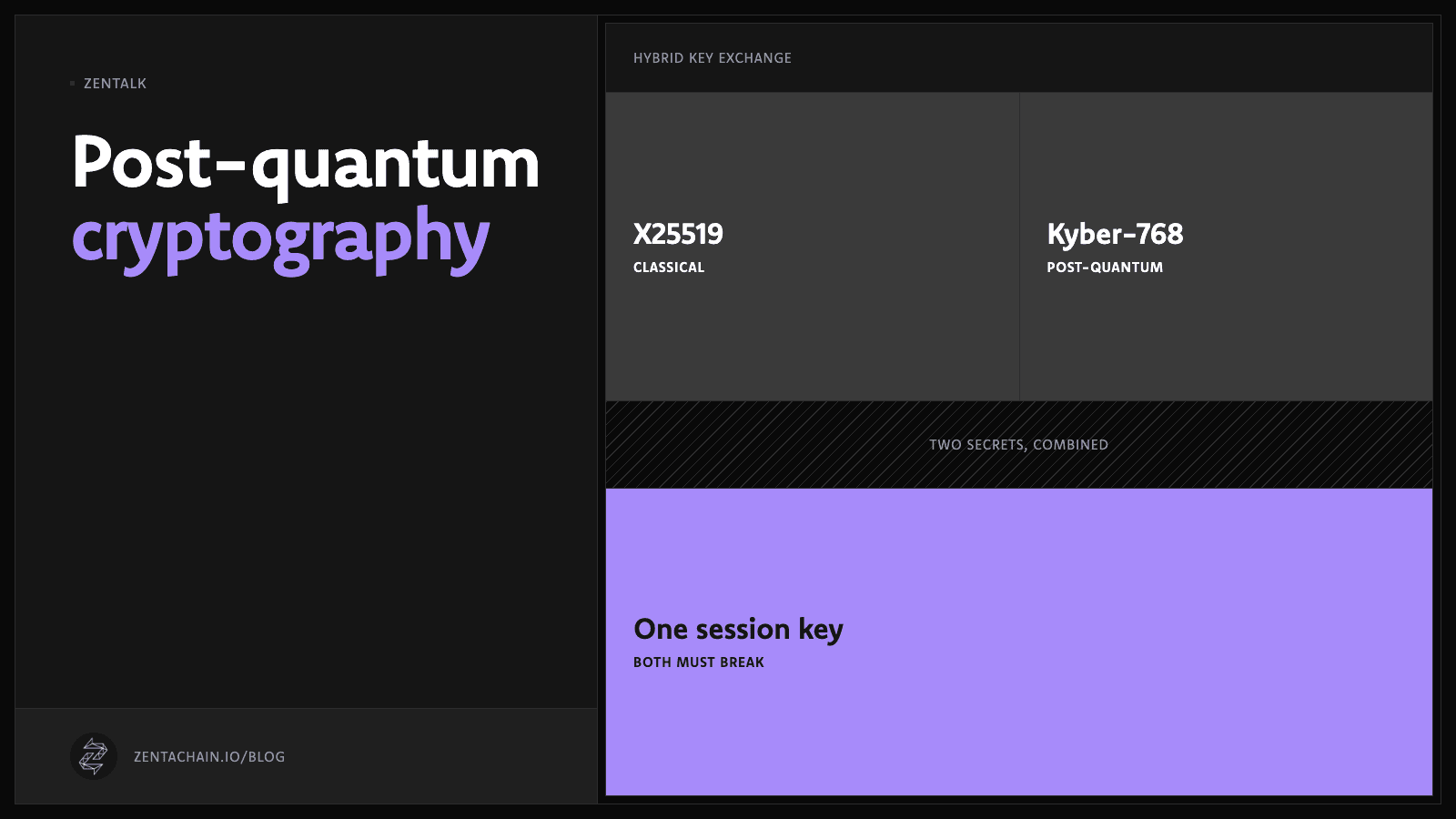
In 1994, a mathematician named Peter Shor proved that a sufficiently large quantum computer could factor integers and compute discrete logarithms in polynomial time. In plain terms, he proved that RSA and every elliptic-curve system deployed on the internet would eventually be breakable. The only question was when.
The when is still unknown. What is known is that intelligence agencies, well-funded criminal groups, and some private research labs are already recording encrypted traffic on the assumption that the when will eventually arrive. The practice has a name: harvest now, decrypt later. Ciphertext captured today, stored cheaply on magnetic tape, decrypted in a decade when the hardware catches up to the mathematics.
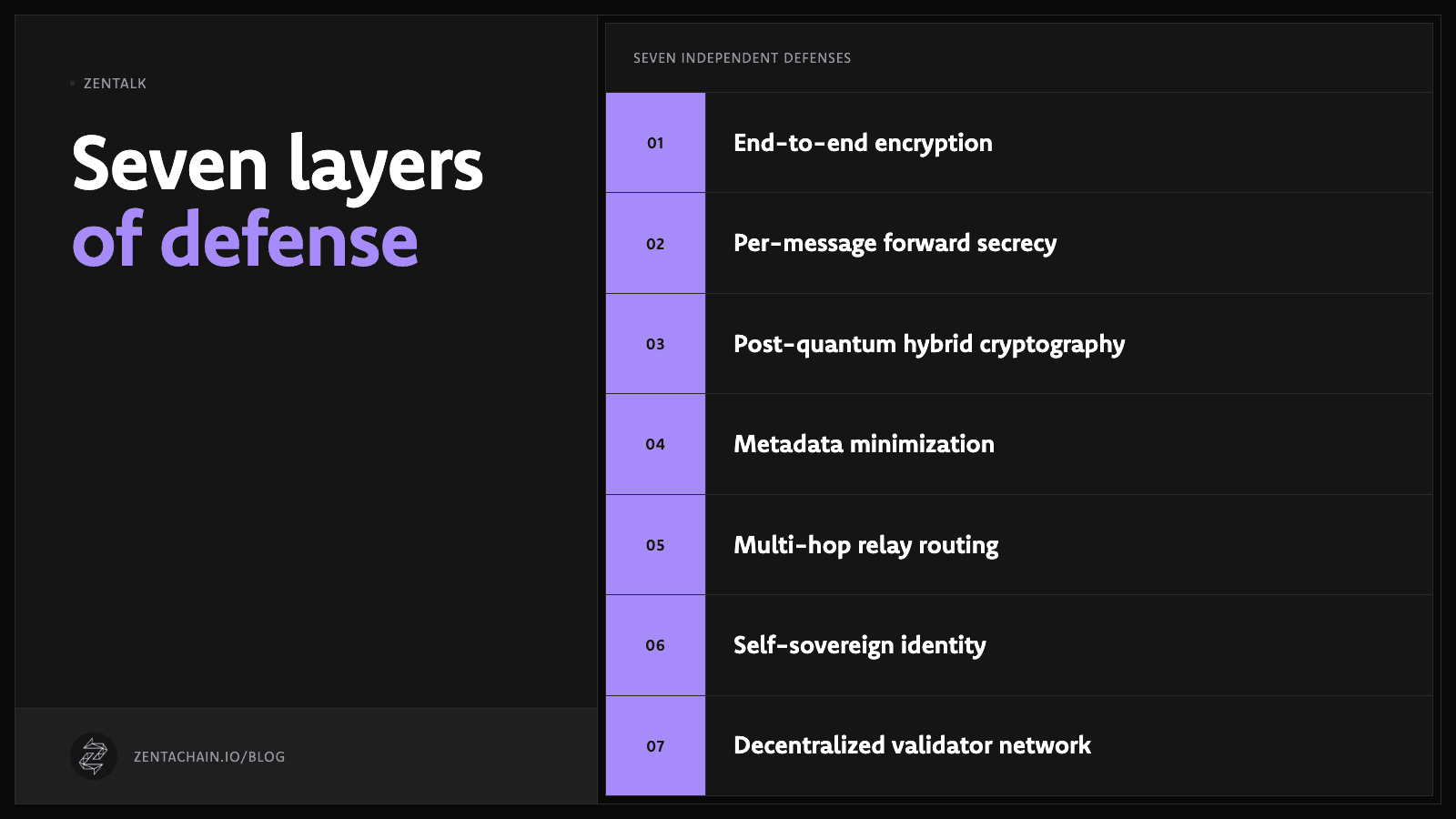
Zentalk does not wait for the decryption window to open. Every key exchange, every signature, every session is already protected by a hybrid scheme that combines classical cryptography with NIST-standardized post-quantum algorithms. The cost to the user is invisible. The gain is that the ciphertext being recorded today will remain unreadable regardless of what hardware exists in 2035.
What breaks
A cryptographically relevant quantum computer needs somewhere between two thousand and four thousand logical qubits to break a 256-bit elliptic-curve key using Shor's algorithm. Public milestones are measured in hundreds of logical qubits. The gap looks large. It is closing faster than the naive extrapolation suggests, because logical qubit counts are a function of physical qubit counts and error-correction overhead, and both are improving on a quarterly cadence at the top labs.
The prudent planning horizon is not the average forecast. It is the shortest plausible one, because decryption is a one-way ratchet. Once the capability exists, every ciphertext recorded before it existed becomes retroactively readable. A messenger whose security depends on pre-quantum key exchange is not secure against a patient adversary. It is secure until the adversary can afford the hardware.
Zentalk's hybrid construction
Key exchange
Every session in Zentalk begins with a dual key exchange. The classical half uses X25519 elliptic-curve Diffie-Hellman, the same primitive trusted by Signal, WireGuard, and most modern TLS deployments. The post-quantum half uses Kyber-768, the lattice-based key-encapsulation mechanism selected by NIST in 2022 after multiple rounds of open competition and international cryptanalysis.
Hybrid Key Exchange:
Two shared secrets — one from X25519, one from Kyber-768 — are combined through a key-derivation function. Breaking the session requires breaking both primitives simultaneously. If either holds, the session key holds.
The two shared secrets are combined with a key-derivation function. The resulting session key is at least as strong as the stronger of the two inputs. If Kyber-768 falls to an unforeseen lattice attack, X25519 still protects the session. If X25519 falls to quantum hardware, Kyber-768 still protects it. Breaking the hybrid requires breaking both.
Signatures
Message authentication and validator signatures use Dilithium-3, another NIST-standardized lattice scheme. Signatures are larger than Ed25519 — several kilobytes rather than sixty-four bytes — but the overhead is paid once per session, not per message. The verification is fast. The security is believed to hold against both classical and quantum attack.
Dilithium-3 Signatures:
Larger than classical Ed25519 signatures, but the cost is amortized across the session lifetime. Verification speed remains fast enough that message throughput is not affected in normal use.
Symmetric encryption
Symmetric ciphers are already quantum-resistant when key sizes are doubled. Zentalk uses AES-256-GCM rather than AES-128. Grover's algorithm provides a quadratic speedup for brute-force key search, which reduces the effective security of AES-128 to 64 bits — insufficient. AES-256 retains 128 bits of effective security even against a quantum brute-force search. Doubling the key was the cheapest defense in the stack.
Why hybrid
The post-quantum standards are new. Kyber and Dilithium have survived several years of public cryptanalysis without a break, but the field is younger than the decades of attack that have shaped confidence in X25519. A break of either scheme is possible, and the response to that possibility has to be engineered in advance. The broader post-quantum migration challenge extends well beyond key exchange alone.
Hybrid constructions solve the problem by refusing to depend on a single assumption. The protocol is secure if at least one of the two primitives holds. That is a much weaker requirement than secure only if both hold. It is also the construction recommended by NIST's own transition guidance, by the IETF working group on post-quantum key exchange, and by most serious security-engineering teams migrating real systems.
Performance
Post-quantum algorithms are not free. Kyber public keys are 1,184 bytes compared to X25519's 32. Dilithium signatures are around 3 kilobytes compared to Ed25519's 64 bytes. On paper, the overhead looks significant.
In practice, the difference is imperceptible on modern hardware. A full Zentalk handshake completes in under 50 milliseconds on a mid-range phone. The bandwidth overhead is negligible compared to a single photograph. The battery impact is below noise. The user does not feel the post-quantum layer. They feel a normal messenger that happens to be resistant to a category of attack that no other mainstream messenger resists.
Migration timeline
NIST has published the transition timeline: post-quantum primitives deployed in all new systems by 2030, legacy pre-quantum cryptography deprecated by the 2035 deadline. That schedule is the official minimum. The operational schedule for high-value targets is earlier, because harvested ciphertext is being collected now.
Zentalk shipped hybrid post-quantum by default in its first public release. Not as a premium feature. Not as an advanced setting. As the baseline. The justification was straightforward: a messenger whose security assumption does not include the next fifteen years of hardware progress is not a messenger designed for privacy. It is a messenger designed for the current threat model and nothing beyond it.
What you can verify
The cryptographic stack is documented, open source, and testable. The key-exchange transcripts can be decoded. The handshake algorithms are specified. The Kyber and Dilithium parameters are the NIST standard parameters, not custom variants. You can audit the implementation against reference implementations. You can benchmark the handshake. You can confirm, independently, that the post-quantum layer is live and not a marketing checkbox.
Privacy as architecture that has to survive the next decade has to be engineered for the next decade. Zentalk's post-quantum defense is not a forecast of when the threat arrives. It is a decision to make the arrival irrelevant.
Thanks & Best Regards Zentachain Team!